
You start noticing the little things. Furniture that rocks no matter how you shim it, a spot in the hallway that gives a bit underfoot, a door that swings open on its own once you let go of the handle, and dishes rattling in the cabinet when someone walks past. Most homeowners chalk it up to an old house having character until the dip in the floor gets noticeable enough to trip over. At A&A Waterproofing, we've been handling floor leveling and structural repairs for homeowners in and around Marietta, GA, since 1996, and the cause is almost always sitting a few feet below the floorboards where nobody has looked in years.
Working from Marietta, GA, A&A Waterproofing is a veteran-owned structural repair and waterproofing service owned and operated by Allen Aschwege. Our team levels and stabilizes uneven floors in existing homes using floor jacking, sagging floor repair, permanent crawl space support systems, beam reinforcement, joist repair, and structural floor stabilization.
The symptoms build up so gradually that people adjust to them. Sloped rooms where a dropped pen rolls toward one wall, gaps opening between the baseboard and the flooring, cracked tile or grout lines that keep reappearing, interior doors that stick or won't close, and soft spots that flex when you step on them. None of this improves on its own, and the floor is generally the last thing to show a problem that started underneath.
The cause usually lives in the crawl space. Moisture down there softens and rots wooden beams and joists over the years, and metal fasteners corrode along with them. Support piers settle into damp soil or were set on inadequate footings when the house went up. Some homes were built with support columns spaced too far apart to begin with, and others have taken on weight from a remodel the original framing was never designed to carry. Termite or beetle damage adds to the list. Whatever the specific reason, something that used to hold the floor level has stopped doing it.
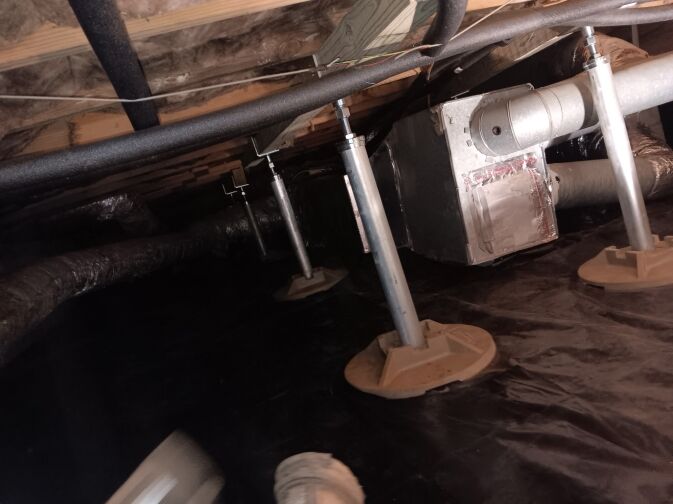
Our repair starts with getting under the house and finding out what failed. From there, the work involves setting properly footed steel or adjustable columns on solid bearing, lifting the sagged area gradually over a period of days rather than forcing it in one afternoon, and replacing or sistering the beams and joists that have deteriorated past the point of holding load. Anything moisture-related gets addressed too, since a dry crawl space is what keeps the repair from becoming necessary again.
The finished result is a floor that sits flat and feels solid underfoot. Doors latch again, the bounce disappears, tile stops cracking, and furniture stays where you put it. Our warranty coverage stands behind the structural work, and homeowners get a repair documented well enough to hand to a buyer down the road.
We always match each repair to the condition of the framing, the source of the movement, and the amount of correction the home can safely handle.

Main girders and support beams carry the weight of everything above them, and decades of crawl space moisture takes a toll on wooden members. Depending on their condition, our crews sister new material alongside the existing beam, replace compromised sections outright, or add support to shorten the span the beam has to cover. Solid structural floor repair starts with making sure the primary supports are actually capable of doing their job.
Floors that flex when you walk across them typically point to joists spanning too far without support underneath, and the fix involves adding columns or a beam to break up that span. Our approach to bouncy floor repair identifies where the deflection is happening rather than treating the whole floor system.
Adjustable steel columns set on poured concrete footings replace the wood posts, stacked blocks, and improvised supports we routinely find under older homes. A properly installed crawl space support system sits on soil capable of carrying the load and can be adjusted during the lifting process to bring the floor back to level. Placement and spacing get worked out based on the framing layout and where the weight actually travels.
Raising a settled floor happens gradually, with small adjustments made over several days so the structure has time to adapt. Rushing the process cracks drywall, breaks tile, and creates a new set of problems upstairs, which is why our floor jacking services move slowly and get monitored throughout. How much correction is achievable depends on the age of the home and how long the sag has been developing, and we'll tell you that honestly before we start.
Individual joists take on rot, insect damage, or splitting long before the rest of the framing does, and they show up as localized soft spots in the floor above. Our floor joist repair work involves sistering new lumber alongside the damaged member or replacing the joist entirely when it's too far gone. Careful sagging floor joist repair also means checking the joists nearby, because whatever damaged one has usually reached its neighbors.
Wood only rots when it stays wet, so leaving a damp crawl space untouched guarantees the same repair will be needed again. Alongside structural work, our team addresses drainage, vapor barriers, and humidity so the new framing stays dry. Pairing crawl space structural repair with moisture control is what turns a fix into a permanent one.
Visible dips and slopes get corrected by identifying every failed support point across the affected area and rebuilding the system that carries the floor. Our approach to sagging floor repair treats the whole picture instead of jacking up the low spot and hoping it holds. Getting the floor back to level often resolves stuck doors and cracked walls upstairs as a bonus.
Some homes need reinforcement that goes beyond leveling, particularly when remodeling added weight the original framing wasn't built for. Additional columns, upgraded footings, and reinforced spans all fall under structural floor stabilization, and the plan comes from what we find during the inspection. Reliable uneven floor repair depends on solving the underlying capacity issue rather than just raising the surface.
At the exterior of your home, cracks, porous masonry, and poor water flow can give moisture an easy route indoors. Our foundation waterproofing service may involve exposing the affected wall, repairing leaks, applying a barrier system, and improving drainage around the structure.
For a basement that feels damp or develops water along the walls and floor, we first consider where the moisture enters and how it moves through the space. We provide basement waterproofing with solutions such as perimeter drains, sump pump connections, leak repairs, and moisture-control measures for finished and unfinished areas.
When cracks begin changing shape or a foundation wall starts leaning inward, a closer inspection can reveal whether reinforcement is needed. We perform foundation repair with options that may include injected sealants, carbon fiber systems, structural stitching, and support for damaged or bowed walls.
Moist ground, open vents, and humid outdoor air can leave the area beneath a home damp for much of the year. Through crawl space repair and encapsulation, we can manage those conditions with sealed liners, dehumidification, drainage, air-control equipment, cleanup, and protective treatments.
Across a poorly draining property, stormwater may collect in low areas or follow the slope directly toward the house. Our French drains and yard drainage work helps guide that runoff elsewhere through subsurface drains, adjusted grades, longer discharge lines, downspout routing, and driveway water collection.
In below-grade spaces, collected water sometimes needs a powered system to carry it outside before it reaches the floor. We handle sump pump installation for new units and replacements, connect pumps with compatible drainage systems, and help property owners consider backup protection.
Over time, shifting or compressed soil can reduce the support beneath part of an existing foundation. Our foundation stabilization services use methods such as helical pier placement, structural lifting, settlement correction, and reinforcement to help support affected load-bearing areas.
Structural work under your home deserves a company you can actually reach afterward, and here's what you get with us.
Crawling under Georgia homes for three decades has shown us most of the ways a floor system can fail, and we take the time to point out exactly what we found so nothing feels like guesswork.
Veteran-owned and locally run means you're dealing directly with the person accountable for the job, not a rotating cast of subcontractors.
Payment options through Acorn Finance let customers tackle the repair on a schedule that works, instead of watching the sag get deeper.
Getting under the house, assessing the framing, and providing a quote costs nothing whatsoever.
Military members, veterans, police officers, firefighters, EMTs, and other first responders take 10% off the job.
Structural repairs come with warranty terms that range from 10 years to lifetime coverage on qualifying projects, based on the scope involved.
Floor jacking can gradually raise affected framing when settled supports, weakened beams, or sagging joists cause the floor to dip. Successful floor leveling and structural repairs also address the underlying damage so the framing has reliable support after the adjustment.
Contractors inspect the joists, beams, posts, supports, moisture conditions, and load paths beneath the moving area. Bouncy floor repair may involve reinforcing joists, adding beams or crawl space supports, repairing damaged wood, and correcting moisture that contributed to the problem.
A sagging floor can signal weakened framing, lost support, foundation movement, moisture damage, or wood deterioration beneath the room. Homeowners should arrange an inspection when the slope worsens, the floor feels soft, or nearby walls and doors begin changing.
Persistent crawl space moisture, plumbing leaks, wood decay, insect damage, poor support, and long-term movement can weaken floor framing. Georgia homeowners should correct the moisture source along with the structural floor repair so damp conditions don't continue affecting the wood.
Repair may make sense when much of the framing remains sound, and contractors can reinforce joists, strengthen beams, or add a crawl space support system. More extensive floor leveling and structural repairs may require replacing sections when decay, breakage, or lost bearing has damaged the wood beyond practical reinforcement.
FAQs reviewed by Allen Aschwege, owner of A&A Waterproofing, an experienced waterproofing service based in Marietta, GA.
Give us a call, and we'll get under the house, find out what's actually failing down there, and explain what it would take to fix it properly.
Business Name: A&A Waterproofing
Address: Marietta, GA, 30064
Phone: 770-443-1155
Business Hours:
Mon - Sat: 8:00 AM to 6:00 PM
Sunday: Closed
Hometown Heroes Discount
We're proud to offer 10% off for veterans, active-duty military, police officers, firefighters, EMTs, and other first responders as a thank-you for your service.
Comprehensive Warranty Coverage
We stand behind the quality of our work. Warranty coverage varies by service and repair, with options ranging from 10-year warranties to lifetime warranties on qualifying projects.