
A house that's sinking on one side rarely announces it directly. Instead, you get a door that stopped latching last year, a gap opening up over the window trim, cracks stair-stepping through the brick mortar outside, and a floor that feels slightly off when you walk toward one end of the room. Homeowners tend to live with these signs for a long time before somebody connects them, and the movement continues the entire time. A&A Waterproofing has been performing foundation stabilization for property owners in Marietta, GA, and the surrounding areas since 1996, and stopping the settlement early keeps a manageable repair from turning into a very expensive one.
A&A Waterproofing, headquartered in Marietta, GA, is a veteran-owned company handling foundation repair, stabilization, and waterproofing, with Allen Aschwege at the helm. Our team provides long-term structural solutions for existing buildings, including helical piers driven to load-bearing soil, settlement repair and controlled lifting to recover lost elevation, permanent structural support, and load-bearing reinforcement that holds the corrected position.
The evidence collects gradually and shows up in several places at once. Diagonal cracking through brick or block, separation where the chimney meets the wall, interior drywall cracks radiating from door corners, floors that slope noticeably toward one side, and windows or doors that have grown stubborn. Cracks that keep widening season after season are the ones that need attention soonest.
Underneath all of it is soil that can no longer carry the load above it. North Georgia clay swells with rainfall and shrinks during dry stretches, and that repeated cycle compresses the ground under a footing until it gives way in one area more than another. Poor drainage accelerates the whole process, and so do tree roots pulling moisture from beneath a corner of the home, erosion under a footing, and fill soil from the original construction that was never compacted properly. When one section of a foundation drops, and the rest stays put, the structure has to absorb that difference somewhere.
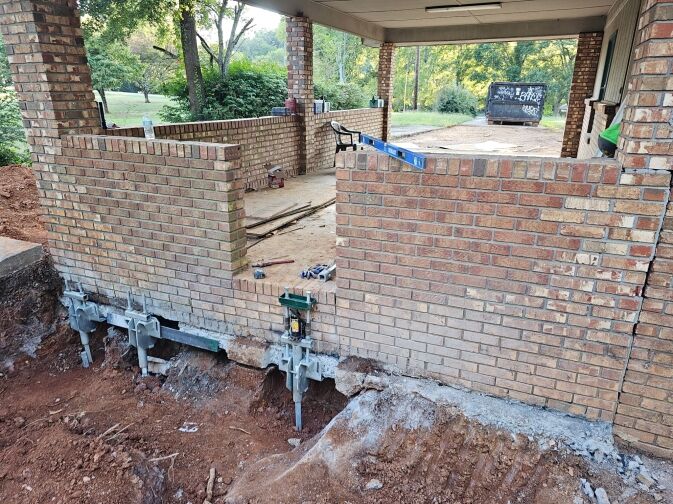
Fixing it means reaching soil that will actually hold. Our crews drive helical piers past the unstable soil and into firm ground well below it, then shift the weight of the house onto brackets mounted at the footing. From there, controlled hydraulic lifting brings the settled section back toward its original elevation as far as the building safely allows, and the load stays permanently supported by the piers rather than the questionable soil.
Once the piers are carrying the weight, the movement stops for good. Cracks can be repaired without reopening, doors and windows generally start operating normally again, and the floors come back closer to level. Our warranty coverage backs the installation, and homeowners get something they can actually document for a future buyer instead of a problem they have to disclose.
Every settling situation has its own cause and its own fix, so here's what our work typically involves.

Diagnosis comes before anything else, since settlement, soil pressure, and simple cosmetic cracking all look similar to an untrained eye. We examine crack patterns, floor elevations, exterior grade, drainage conditions, and overall structural behavior to determine what's really happening. Honest settling foundation repair starts with telling people when the situation is stable and doesn't require piers at all.
Bringing a dropped section back up happens slowly and under close watch, using hydraulic jacks working in sequence across the pier locations. How much elevation can safely be recovered depends on the age of the structure, the materials involved, and how long it has been settling, so we set realistic expectations before starting. Careful foundation lifting closes cracks and restores door and window operation without introducing new damage upstairs.
Steel shafts with helical plates get screwed into the ground much like a giant auger, advancing past the weak soil until torque readings confirm they've reached competent bearing material. Helical pier installation works year-round, requires less excavation than other methods, and can be loaded immediately once installed. Our crews document torque and depth at every location so there's a record of what the system is actually seated in.
Transferring a structure's weight onto a new support system requires understanding how the load travels through the building. Bracket placement, pier spacing, and capacity all get calculated for the specific structure rather than applied from a template. Proper structural foundation repair distributes that load evenly so no single point takes more than it should.
Where the piers go matters as much as the piers themselves, and spacing gets determined by wall construction, load paths, and the extent of the settled area. Our team maps out the plan during the assessment and explains why each location was chosen. Thoughtful foundation pier installation uses the right number of piers in the right places rather than the largest quantity that could be justified.
Correcting the drop is one piece, and addressing whatever caused it is the other. Alongside the pier work, we look at drainage, grading, and downspout discharge, because saturated soil under a footing will keep causing trouble regardless of what's holding the house up. Complete foundation settlement repair handles the structure and the conditions around it together.
Certain situations call for reinforcement beyond piers, including support beams, additional piers under interior load-bearing points, or bracing tied into stabilization work elsewhere on the building. Recommendations come from what the structure actually needs, and we present options at different scopes and price points. Effective sinking foundation repair matches the solution to the severity instead of defaulting to the largest job available.
Georgia rain and clay-heavy soil can keep moisture pressed against exterior foundation walls long after a storm passes. Our foundation waterproofing approach may combine excavation, wall sealing, waterproof membranes, coatings, and drainage upgrades based on how water is reaching the structure.
Water marks, damp flooring, and a lingering earthy smell can make even a finished basement feel unusable. Through basement waterproofing, we install or repair interior drainage components, manage incoming moisture, address leaks, and connect sump pumps when active water removal is needed.
Small cracks may stay stable for years, while widening gaps or inward wall movement can indicate a more serious concern. We begin foundation repair by evaluating the visible damage, then use suitable methods such as injection repairs, carbon fiber reinforcement, stitching, or bowing wall support.
Warm, humid air beneath a house can settle on cooler surfaces and leave framing or insulation damp. Our crawl space repair and encapsulation work can include ground liners, sealed barriers, drainage, dehumidifiers, ventilation changes, cleanup, and fungal treatment where appropriate.
Rainwater shouldn't spend the afternoon sitting beside your house or turning the lawn into a small pond. We design French drains and yard drainage improvements using grading adjustments, collection drains, extended downspouts, drain piping, driveway drains, and routes that carry runoff toward a safer discharge area.
Low areas below ground level sometimes need mechanical drainage because water can't flow away on its own. With our sump pump installation service, we can place or replace pumps, connect them to the drainage setup, review discharge needs, and discuss backup options for periods of heavy rainfall or power loss.
Uneven rooms and floors that shake under normal footsteps often point to an issue with the supporting framework below. We perform floor leveling and structural repairs through measured jacking, joist restoration, beam strengthening, crawl space supports, and other repairs selected for the affected floor system.
We make structural concerns easier to understand by offering clear explanations, practical options, and recommendations based on what the property actually needs.
Reading settlement patterns takes years to learn, and after three decades, we can usually tell you what's moving and why before we've finished the walk-through.
Service left Allen with a low tolerance for cutting corners, and that carries into how our veteran-owned company approaches every foundation we touch.
Acorn Finance handles financing on our projects, which keeps a structural repair from waiting while the settlement continues.
Inspecting the property and providing a full assessment carries no charge and no obligation.
Anyone serving or formerly serving in the military, law enforcement, fire service, or emergency medical services professionals gets 10% off.
Warranties on qualifying foundation stabilization services extend from 10 years out to lifetime coverage, with terms based on the specific work performed.
Helical piers can support an existing foundation by transferring its load through unstable soil to stronger material below. Depending on the structure and amount of settlement, contractors may also use the pier system for controlled foundation lifting as part of a broader foundation stabilization plan.
Contractors inspect the crack patterns, elevation changes, soil conditions, drainage, and affected load-bearing areas before choosing a repair. Foundation stabilization may involve helical piers, brackets, structural support, settlement correction, or limited lifting based on the findings.
Settlement deserves prompt attention when cracks widen, floors slope, doors begin sticking, or walls and openings shift noticeably. An early inspection helps determine whether the home needs monitoring, drainage improvements, foundation settlement repair, or structural support.
Common warning signs include stair-step masonry cracks, gaps around windows, sloping floors, sticking doors, separated trim, and portions of the foundation that appear lower than nearby areas. A professional inspection connects those symptoms to their source before anyone recommends foundation stabilization services.
Contractors may recommend helical pier installation when weak or shifting soil no longer provides dependable support beneath an existing foundation. The pier and bracket system carries structural loads to stronger soil, but the project design must account for the building, load requirements, and ground conditions.
FAQs reviewed by Allen Aschwege, owner of A&A Waterproofing, an experienced waterproofing service based in Marietta, GA.
Foundation settlement deserves a thoughtful look before movement leads to more repairs above it. Contact us to arrange a free foundation stabilization estimate.
Business Name: A&A Waterproofing
Address: Marietta, GA, 30064
Phone: 770-443-1155
Business Hours:
Mon - Sat: 8:00 AM to 6:00 PM
Sunday: Closed
Hometown Heroes Discount
We're proud to offer 10% off for veterans, active-duty military, police officers, firefighters, EMTs, and other first responders as a thank-you for your service.
Comprehensive Warranty Coverage
We stand behind the quality of our work. Warranty coverage varies by service and repair, with options ranging from 10-year warranties to lifetime warranties on qualifying projects.